
Iterations, final_final files, prototypes and dusty workshops.

Making of Cello
It took nearly 500 hours. I worked under the supervision of Professor and master luthier Vilim Demšar in his studio in Ljubljana.
The quality of the sound can only be judged once the instrument is finished. Anticipation is tangible after the entire journey through the process, overarching the mistakes and learnings.


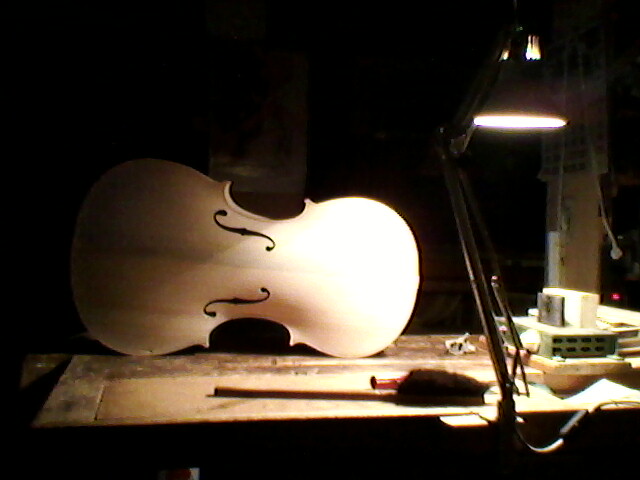
The convexity of boards for optimal acoustics depends on the density of the wood. It is measured and calculated for each individual piece. The curvature shape is carved out by hand with variety of tools.
Wooden boards must first be left to dry for nearly a decade. If used prematurely, deformations would occur, ultimately destroying the instrument.
Stringed instruments are mostly made of maple, but spruce, linden, and ebony are also used.
I learned to use both standard woodworking tools and luthier-specific tools. The organic properties of wood dictate different techniques. The variety of tools ranges from electric saws, chisels, clamps, gouges, and benders to finger-sized chisels.
I was faced with very specific procedures, such as sawing f-holes, adding an acoustic rib, and inserting veneer strips into the flute at the edge. The sides, made of thin strips of maple, were curved using steam. The thinner edges must be joined precisely. The formats and templates are determined by the instrument’s size.
Once the convex boards are ready and the sides are joined to the rim, glueing follows. Edge strips and battens are inserted inside for stabilisation. A specialised adhesive is used, as the instrument must be opened for repair.
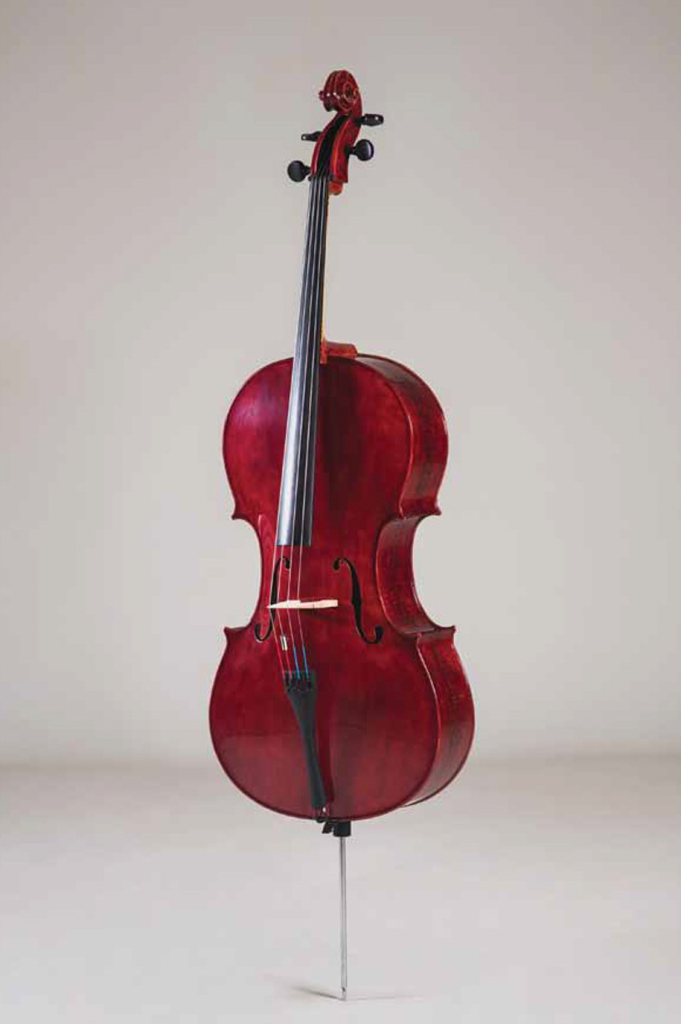
Between the layers of varnish, I’ve drawn a pattern in ink, a technique used by old Italian masters.
Varnish is applied with a brush in several layers over several days. Mixing pigment into colourless varnish, then applying it daily, produces the desired shade.

Light also helps in the process, for example, by observing the regularity of shadow gaps. I find it interesting to think about how light is a tool in the production of musical instruments.
Wooden Handle
Using the woods’ characteristics as an expressive design feature.

A door handle is a handshake with the space we are about to enter. Some kind of first contact, first impression, perhaps a hint about what is hiding behind the door.
A door handle is so common that it barely gets any attention; its sole purpose is to open and close the door.
While public or commercial buildings must comply with standards and requirements (safety, durability, materiality) to accommodate high user frequency, domestic spaces can be personalised to the last detail. Objects in constant use must be precisely designed, and ergonomics are critical. Size, shape, surface, stiffness.


Ergonomics were tested with the help of palm samples made out of foam and plasticine. Shape is a negative space of a palm.
“The general hand-machine problem: Handles are often too small, too stiff, sharp, awkwardly placed, and confusing to use. […] The simple act of gripping a hand-rail to support the body can suggest the desirable thickness, length, and position of a general-purpose handle, and perhaps some other criteria as well.” Patkin, 2001

The final product is made of larch timber, with metal connector hooks of iron and brass, a built-in thorn for a lock system and a rosette for the key.
Studio photos of cello and handle: A. Vrabl
Kamishibai Kai Website
An ancient Japanese art of storytelling. A modern didactic tool in classrooms.

Logo, branding, website design and content (images, graphics, copywriting) for Kamishibai Kai.
Logo is a geometric version of a wooden suitcase, Butai. It represents the moment of opening up the sides when the story begins – as when the curtains go up in the theatre.


visit Kamishibai Kai website