
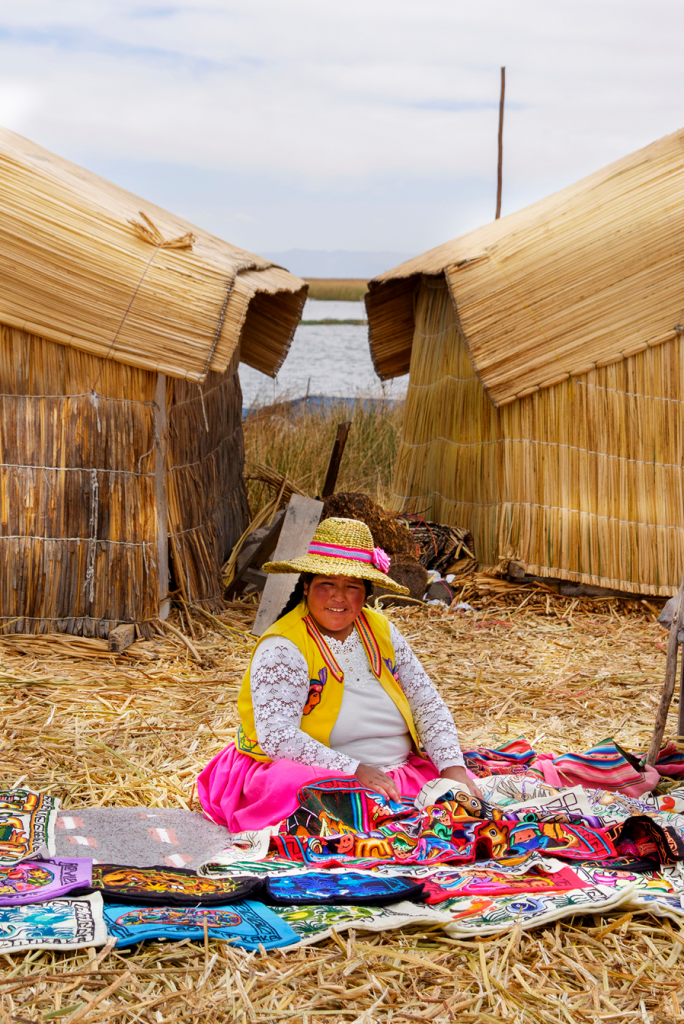
Visiting indigenous communities on the world’s highest navigable lake offered insight into isolated rural ways of life. Each community has preserved its unique socio-political and ethnic heritage.
Uros Islands
There are about 120 artificial floating islands, made of chopped roots and layers of endemic totora reeds. Blocks are tied together with the rope and anchored to the seabed to resist wind and currents. Building a new island every 15 years seems to be the only worry; they occupy their time with vibrant textile crafts and fishing. Their nutrition is based on the bounty of the lake and surroundings – staple fish, totora reeds for the iodine, hunted birds and eggs and crops. The meals are prepared over the stone hearths or fire.
Each island accommodates a couple of families and has a chief as its authority. ‘’He helps them to solve personal problems too. They can usually work it out. And if they can’t, they just cut the island in half and drift apart,’’ said the guide.
Amantani Island
A modest homestay had walls painted a rich orange. A patio where children played was paved with a black-and-white pebble pattern. From there, you could see our host, in traditional clothing, preparing a dining table. Simple, yet delicious meal: smoking hot quinoa soup, various types of potato, corn, beans and grilled cheese. And in the background, through the second window, the landscape, bathed in pre-dinner time light. What a cinematic sequence.
Villagers gathered at the sports field, and old ladies in long skirts played ball with the children; time barely existed there. Life was simple but not easy – work in the fields started early, and the choice of crops was limited. In the evening, our host, with a baby wrapped in a cloth around her back, walked us to the community room. We were all wearing their indigenous clothing – long skirts and ponchos and joined the locals for a dance.
Taquile Island
A hilly grassland, a coastline with small coves and water that stretches to the horizon. Quiet and almost uninhabited. This is how I imagined a remote island in the Mediterranean Sea, not a lake in Peru. Sometimes you go to the other side of the world to find a familiar place.
The peculiarity of this community was its strict rules about clothing, which seemed almost like a form of surveillance of social/domestic norms: the shape, colour, and pattern of their hats, belts, and coca-leaf shoulder bag would reveal their marital status.
They are still largely dependent on the abundance or scarcity of natural resources. What has changed is the regularity of tourist boats, which means a sort of income from selling crafts. Many now have small solar panels, technology on a pole, sticking out of the ground next to a reed-made house. They are distributed by the government. Renewable energy reduces reliance on candles and fossil fuels and powers small TVs and even schools.
(excerpt from Sacred and Mundane)