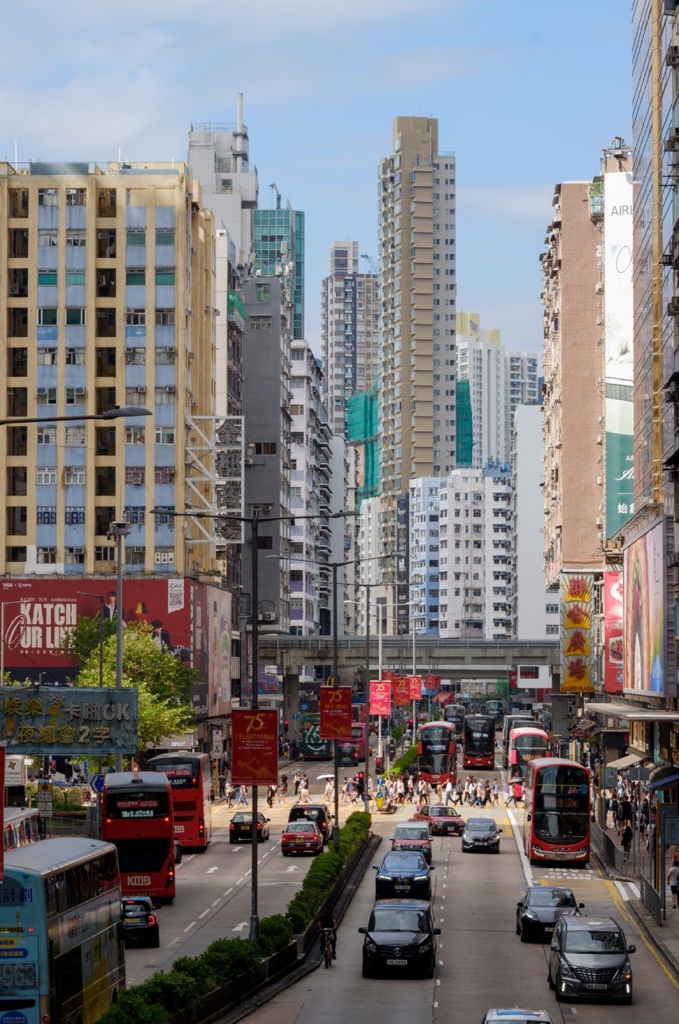
Hong Kong was a synonym for cinema and hyperdensity. Cage homes, Dim Sum, old belief and new ambition. The topics felt like a stimulating opening scene of a lengthy journey. Cultural fluidity was shaped by the colonial past, geographic boundaries with limited flat areas, and the hybrid identity of East and West.
One of the first things I noticed was an ad for The Bank of East Asia, abbreviated simply to BEA. The slogan read: “Be wealthy, not rich.” I chuckled. It made sense in the context of Hong Kong’s status as a global financial hub. But it also sounded like something Bea might have said with her smugness. From that moment, I knew that this trip would belong to both Eva and Bea.
The next thing I noticed was posters celebrating the 75th anniversary of the founding of the People’s Republic of China. They plastered the city, underlining the uncertainty. Democratic freedoms made under the “One country, two systems” framework are slowly but visibly eroding. Political autonomy cracks down on dissent. On the other hand, it is an established gateway to mainland China – commerce and trade keep the streets busy. It was clean, business-oriented, and urgent—nobody smiled, everyone was in motion.
At the Monster Building in Quarry Bay, I confronted Hong Kong’s super-density. Housing nearly 10,000 people, this five-building complex is both iconic and problematic. Ownership regulations stall maintenance, and necessary repairs can not be carried out. Illegal renovations hinder building assessment.
The consequences of limited public housing led to the reality of “Cage homes” in several districts. Often made of wire cages, up to a dozen so-called “Bedspace apartments” are stacked within a single apartment. When more, the landlord needs to get a license.
And then Sunday arrived, and the sidewalks bloomed. Thousands of Filipino domestic workers, the invisible engine behind Hong Kong’s households, reclaimed public space. The community gathered for trading and laughter, offering services like haircuts in the parks. Their presence reconfigured the city’s rhythm, even in a business district.
City’s unique position as a Chinese city under British rule, a global trade port, and a cultural crossroads created the circumstances for a distinctive cinematic language – neither Eastern nor Western. This fusion created aesthetics that mirrored the city’s complex identity, struggles, and transitions.
During the post-war “Golden Age”, influential film directors emerged, and genres diversified. Global action cinema was characterised by signature styles such as gun-fu and martial arts, with the industry specialising in wuxia (swordplay) and melodrama. It was accelerated by Western technology and an influx of talent from mainland China. By the 1950s, the city’s iconic neon signs had become widespread. These glowing symbols of consumerism and modernity also provided the perfect cinematic backdrop.
“I ate the entire Hong Kong,” I said, illuminated by glowing signs. “If it goes on like this, I will come back as King Kong.” The streets were bright, and LED lights replaced the neon signs. But their visual impact remained part of the city’s cultural legacy.
“My eyes are big when ordering food, but my stomach is even bigger – and adaptable,” said Bea proudly. She licked her fingers after demolishing a platter of dim sum and street-grilled seafood. She burped, not particularly quietly, as if that made enough room for the next endeavour. Then she demanded: “Turnip cakes!”
(excerpt from Four Months)